
Homes, acreages and shops across Lancaster County
Spray Foam Insulation in Lincoln, NE
Seal the drafts behind cold January floors and hot July bedrooms, with foam where it pays and blown-in where it does the job for less.
- Free on-site estimates
- Written quote with material, thickness and R-value for each area
- Air leaks and moisture checked before anything gets covered
Insulation for Both Ends of a Nebraska Year
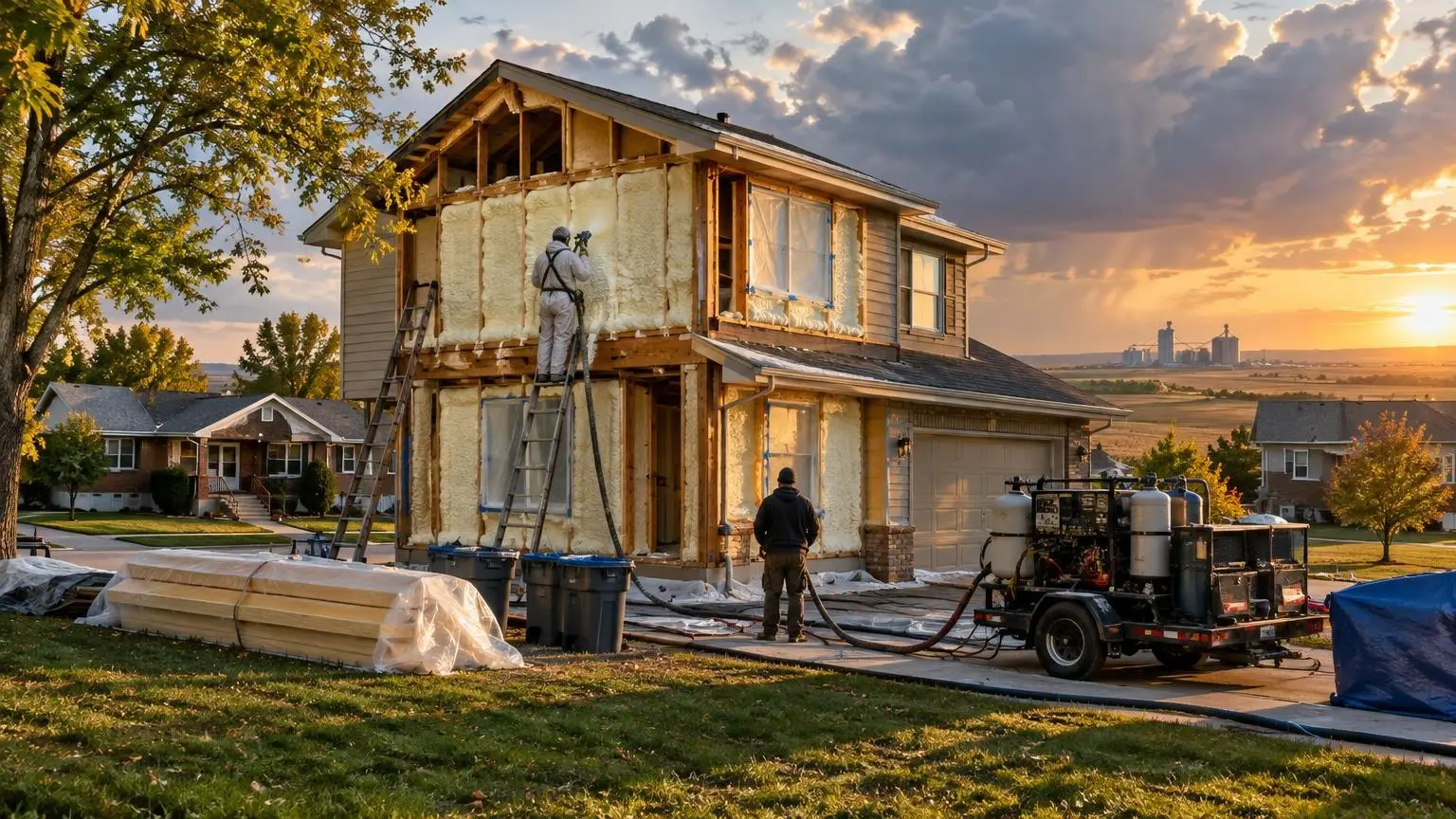
Spray foam insulation in Lincoln has to work hard in two directions. The city's 1991-2020 climate normals put the average January low at 14.4F and the average July day at 78.1F, with a record low of -33F and a record high of 115F. A house here is heated for months and cooled for months, and every gap in its shell costs money in both seasons. We seal those gaps and insulate the spaces that need it, using open-cell or closed-cell spray foam where it makes sense and blown-in insulation where that is the smarter buy.
What Nebraska code asks for
Nebraska adopted the 2018 International Energy Conservation Code statewide on July 1, 2020, and Lancaster County sits in Climate Zone 5. The state energy office's fact sheet for that code lists R-49 for ceilings, R-20 (or R-13 plus R-5 continuous) for wood-frame walls, R-30 for floors, R-19 cavity or R-15 continuous for basement and crawl space walls, and R-10 for slab edges. New homes also have to pass a blower door test at 3 air changes per hour or less. Older houses are not required to meet those numbers, but they are a useful yardstick: many Lincoln attics we look at hold well under R-30, and plenty of older walls hold nothing at all.
Where Lincoln houses lose heat
Lincoln was settled in 1856 as the village of Lancaster and became the state capital in 1869. It grew by absorbing its neighbors: Bethany Heights in 1922, University Place in 1926, College View in 1929, Havelock in 1930 and West Lincoln in 1966. That leaves a city with every era of house, from the 1869 Kennard House near the Capitol to brand-new subdivisions at the edges. A two-story in an older neighborhood often has open wall cavities running straight into the attic. A 1950s ranch usually has a thin attic and a leaky rim joist. A newer house with a bonus room over the garage tends to have one room that never matches the thermostat. The 2020 census counted 122,048 housing units in the city, and nearly all of them leak in one of those places.
Spray foam insulation contractors: what to ask
When you compare spray foam insulation companies or general insulation contractors, ask each one the same things. Which areas will be foamed and which will get blown-in insulation? Open cell or closed cell, and how many inches? What R-value will each area reach? How long should the house be empty while foam cures? Will an ignition or thermal barrier be needed over exposed foam? A clear answer to each, in writing, is a better sign than a low square-foot number over the phone.
Closed cell vs open cell
Closed-cell foam is dense and rigid, blocks air and water vapor, and gives more R-value per inch. It is the usual choice for rim joists, basement walls, metal buildings and anywhere moisture is a concern. Open-cell foam is softer, expands much more, costs less per square foot and fills irregular cavities well, which makes it common on roof decks and in interior walls. Many jobs use both.
Spray foam insulation cost
National cost guides from HomeGuide and Fixr put installed spray foam at roughly $1.50 to $5.00 per square foot, and whole-house jobs at $8,000 to $30,000 depending on the source and scope. Attic, wall, basement and shop work each has its own range, which you will find on the service pages. Two local programs can change the math: Lincoln Electric System (LES) lists a 2026 sealing and insulation incentive for existing homes with empty walls or attics at R-19 or less, and the state's Dollar and Energy Saving Loans cover insulation and air sealing. We explain both on the visit.
Get a free estimate or call (402) 787-4587 to set up a time.
Why Homeowners Call Spray Foam Insulation Lincoln
We look before we price
An attic, basement and rim joist check comes before any number, so the quote fits your house, not a square-foot guess.
Every area itemized
Material, thickness, R-value and price for each space, so you can compare insulation companies line by line.
Foam where it earns it
If blown-in insulation over a sealed ceiling does the job for less, that is what we recommend.
Rebate rules explained
We walk through what LES and the state loan program require, including blower door tests and pre-approval, before work starts.

Common Questions
How much should I expect to pay for spray foam insulation?
HomeGuide puts installed spray foam at $1.50 to $3.50 per square foot for open cell and $3.00 to $5.00 for closed cell. Most single-area jobs land between $1,500 and $5,000, while whole-house work runs $8,000 to $20,000 (HomeGuide) or $10,000 to $30,000 (Fixr). Your written estimate after the visit is the real number.
How much does it cost to spray foam 2,000 square feet?
At HomeGuide's $1.50 to $5.00 per square foot, 2,000 square feet of sprayed surface works out to about $3,000 to $10,000. Note that this means 2,000 square feet of wall, roof deck or floor area being sprayed, not a 2,000 square foot house, which has far more surface than that. Thickness and foam type move the number most.
Is there a downside to spray foam insulation?
Yes, a few. It costs more than blown-in insulation, the house needs to be empty while it cures, and once it is on it is hard to remove. It also covers up wiring and framing, so problems need to be found first. That is why we check for leaks, moisture and old wiring before spraying.
What R-value does Nebraska require in an attic?
Nebraska's statewide code is the 2018 IECC, adopted July 1, 2020, and its fact sheet lists R-49 for ceilings in new construction and additions. Existing homes are not forced to upgrade, but LES uses the same R-49 attic target in its 2026 insulation incentive.
Does LES pay for insulation?
LES lists a 2026 Residential and Commercial Sealing and Insulation incentive of $0.80 per square foot for wall insulation and $0.50 per square foot for attic insulation, up to $1,500 per property. It applies to existing homes with no wall insulation or attic insulation at R-19 or less, and requires pre-authorization and blower door tests before and after. Funds are first come, first served.
Closed cell vs open cell: which is right for my house?
Closed cell for rim joists, basement walls, crawl spaces and metal buildings, where you want an air and vapor barrier and high R-value per inch. Open cell for roof decks and interior cavities where lower cost and full fill matter more. We will mark which goes where on your quote.
How do I choose an insulation company in Lincoln, Nebraska?
Get at least two written quotes that list material, thickness and R-value for each area. Ask how they handle air sealing, ventilation baffles, cure time and ignition barriers, and whether they will help with LES incentive paperwork. Compare the scope, not just the total.
Can spray foam stop a wet basement?
No. Closed-cell foam blocks air and vapor, but it is not a fix for water coming through a foundation. Leaks, grading and gutters need to be dealt with first, and we will tell you if we see signs of water before we spray.
Where We Work
We work across Lincoln and Lancaster County: Waverly to the northeast, Bennet and Hickman to the southeast, Firth at the county's southern edge, and Malcolm near Branched Oak and Pawnee lakes. We also take jobs in Eagle in Cass County, Ashland and Wahoo in Saunders County, Seward and Milford in Seward County, Crete in Saline County and Beatrice in Gage County. The housing changes as you move out from the city. Waverly, Hickman and Bennet have grown fast and have many newer homes with bonus rooms and finished basements. Railroad towns like Firth, Eagle and Malcolm have older cores with farmhouses and shops on acreages around them. County seats like Seward, Wahoo and Beatrice have historic houses near the square and newer ranches at the edge of town. Each town page lists what we know about housing and climate there.
- Spray Foam Insulation in Lincoln, NE
- Spray Foam Insulation in Waverly, NE
- Spray Foam Insulation in Hickman, NE
- Spray Foam Insulation in Bennet, NE
- Spray Foam Insulation in Firth, NE
- Spray Foam Insulation in Malcolm, NE
- Spray Foam Insulation in Eagle, NE
- Spray Foam Insulation in Crete, NE
- Spray Foam Insulation in Milford, NE
- Spray Foam Insulation in Seward, NE
- Spray Foam Insulation in Ashland, NE
- Spray Foam Insulation in Wahoo, NE
- Spray Foam Insulation in Beatrice, NE

Our Services
Six kinds of work cover nearly every insulation call we get in Lincoln and the towns around it.
Spray Foam Insulation
Open-cell or closed-cell foam that insulates and air seals in one pass, matched to each surface.
Learn more →Attic Insulation & Air Sealing
Seal the holes in the top-floor ceiling, then bring the attic up toward R-49.
Learn more →Wall Insulation
Dense-pack or injection insulation for finished walls, and spray foam for open framing.
Learn more →Basement & Rim Joist Insulation
Closed-cell foam on rim joists and foundation walls, so the basement stops pulling in cold air.
Learn more →Pole Barn & Metal Building Insulation
Closed-cell foam for steel shops, pole barns and garages that drip in winter and bake in summer.
Learn more →Insulation Removal & Replacement
Take out wet, dirty or contaminated insulation, seal the space, and put the right material back.
Learn more →Get a Spray Foam Insulation Estimate
Tell us which rooms are uncomfortable. We will find out why and put the fix and the price in writing.