
Open cell, closed cell, or both
Spray Foam Insulation in Lincoln, NE
One layer that stops air leaks and insulates, placed where a Lincoln house actually loses heat and gains it.
- Free on-site estimates
- Written quote with material, thickness and R-value for each area
- Air leaks and moisture checked before anything gets covered
What Spray Foam Does That Other Insulation Does Not
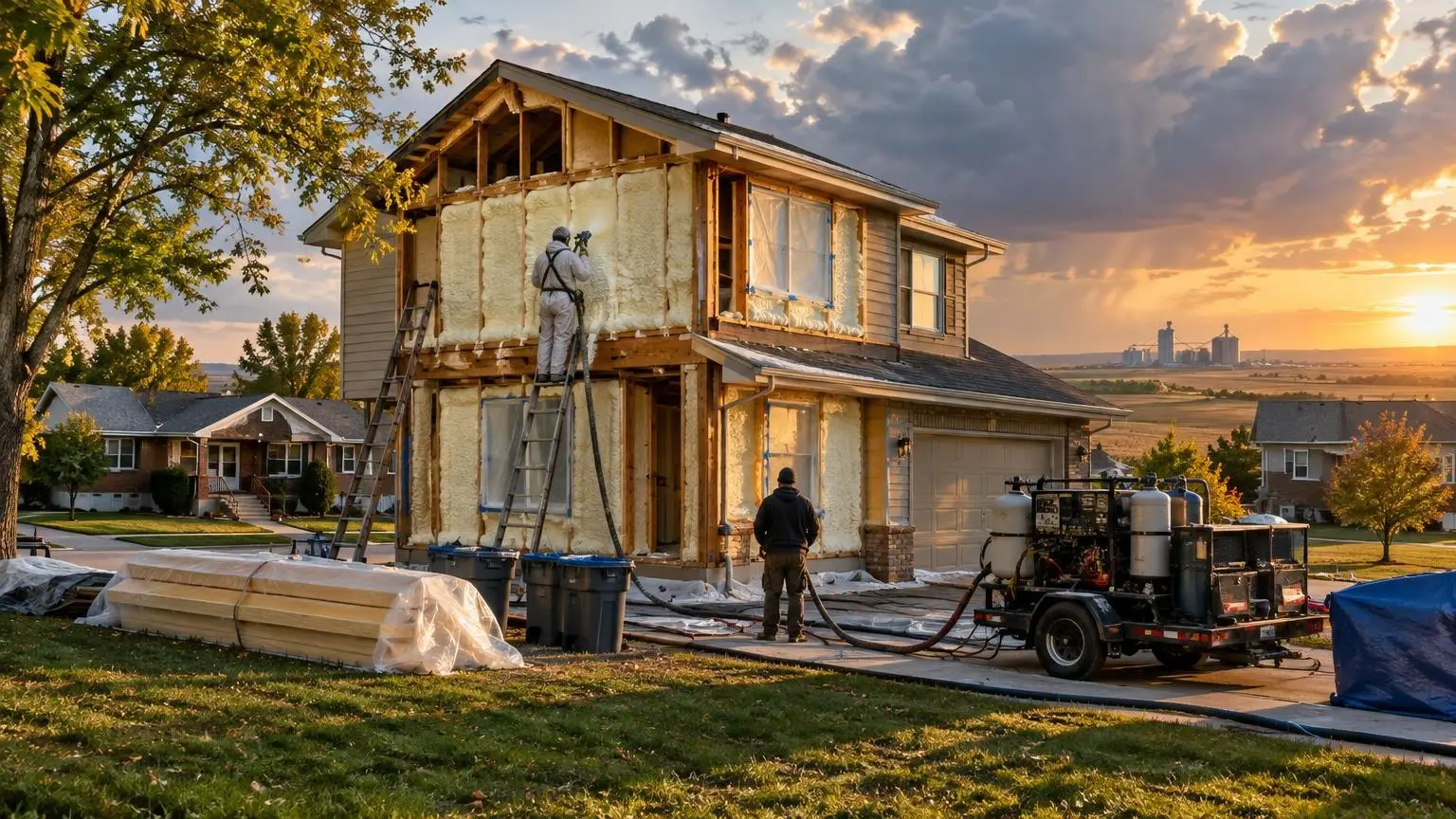
Spray foam insulation is a two-part liquid that expands as it is sprayed, sticks to the surface and hardens in place. Unlike fiberglass batts or loose fill, it fills cracks and seams as it goes, so one layer both insulates and stops air from moving through. In Lincoln, where the 1991-2020 normals show a 14.4F average January low and a 78.1F average July day, that air seal matters in both seasons: it keeps heated air in through winter and humid air out through summer.
Closed cell vs open cell
There are two kinds of spray foam, and most houses can use both.
Closed-cell foam is dense and rigid. HomeGuide lists it at R-5 to R-7 per inch, and at normal thickness it also slows water vapor. It adds stiffness to what it is sprayed on and does not soak up water. That makes it the usual pick for rim joists, basement and crawl space walls, metal buildings and anywhere condensation is a risk.
Open-cell foam is soft and spongy, listed by HomeGuide at R-3.5 to R-3.7 per inch. It expands far more than closed cell, filling odd-shaped cavities completely, and costs less per square foot. It is common on roof decks when an attic is brought inside the heated space, and in interior walls where sound is a concern. It lets vapor pass, so it is not used where it could get wet.
Who needs it
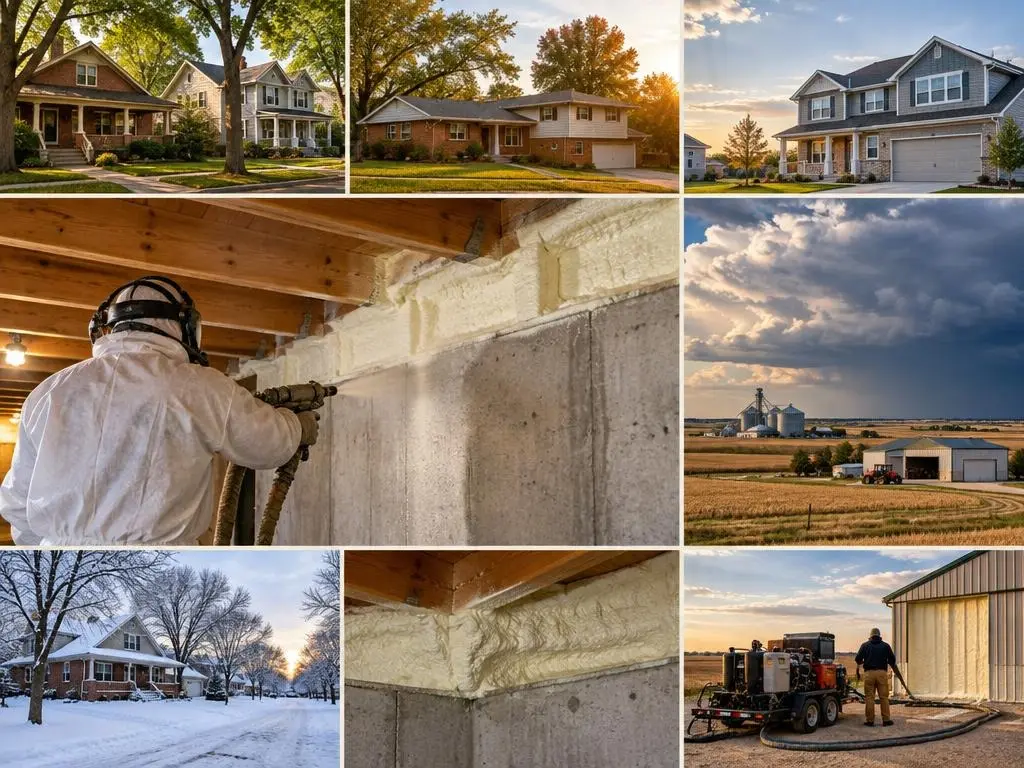
Spray foam earns its cost in spaces that are hard to seal any other way. The rim joist, the band of framing that sits on the foundation wall, leaks air all the way around most Lincoln basements. Bonus rooms over garages have floors, kneewalls and sloped ceilings that batts never fill well. Cathedral ceilings and finished attics have no room for loose fill. Pole barns and steel shops drip without a vapor-tight layer. In each of those places, foam does what fiberglass cannot.
How to tell if it would help
Signs that point toward foam: a room that is always several degrees off the thermostat, cold floors over a garage or crawl space, frost or dampness on the rim joist in winter, drafts at baseboards, or a basement you are about to finish. If the problem is simply a thin attic floor, blown-in insulation over a sealed ceiling is often the better value, and we will say so.
Code and safety
Nebraska's 2018 IECC, in force statewide since July 1, 2020, sets R-values for new work such as basement walls at R-19 cavity or R-15 continuous. Foam left exposed inside living or storage space generally needs a thermal or ignition barrier over it, and we will tell you on the quote where that applies. During and after spraying the house needs to be empty and ventilated; HomeGuide advises staying out for at least 24 hours.
Get a free estimate or call (402) 795-8689 and we will come measure.
Where We Spray
The spots in Lincoln-area homes and buildings where foam is usually the right material.
Rim joists and band boards
Closed-cell foam on the framing that sits on the foundation, sealing the leak that runs the whole perimeter of the basement.
Roof decks and unvented attics
Open- or closed-cell foam on the underside of the roof so ducts and equipment in the attic sit inside the conditioned space.
Bonus rooms and kneewalls
Foam on the floor over the garage, the short walls and the sloped ceiling that make bonus rooms run hot and cold.
New construction and additions
Open stud and rafter bays sprayed before drywall, sized to the R-values in Nebraska's energy code.
Basement and crawl space walls
Closed-cell foam on concrete walls ahead of framing, giving air sealing and insulation without trapping moisture in batts.

Typical Spray Foam Insulation Costs
| Job | Range and source |
|---|---|
| Spray foam, installed | $1.50 to $5.00 per sq ft (HomeGuide) |
| Open-cell / closed-cell | $1.50 to $3.50 / $3.00 to $5.00 per sq ft (HomeGuide) |
| About 1,000 sq ft | $1,500 to $5,000 (HomeGuide); $3,150 to $7,500 existing home (Fixr) |
| Existing walls / new construction | $3.15 to $7.50 / $2.75 to $6.50 per sq ft (Fixr) |
| All exterior walls | $4,000 to $10,000 (HomeGuide) |
| Whole house | $8,000 to $20,000 (HomeGuide); $10,000 to $30,000 (Fixr) |
| Typical job minimum | $1,000 to $2,000+ (HomeGuide) |
National ranges from HomeGuide's 2026 spray foam guide and Fixr's 2025 guide, not Lincoln quotes. Foam type, inches applied, access and prep work set the total, and small jobs often hit a minimum. The price you pay is the one on your written estimate.
How a Spray Foam Job Goes
1. Walk-through
We look at each space, check for moisture, wiring and leaks, and measure the surfaces.
2. Written quote
Each area gets a foam type, thickness, R-value and price, plus any barrier needed over exposed foam.
3. Prep and spray
We cover floors and fixtures, close off the work area, set up ventilation and spray in passes.
4. Cure and clean up
The house stays empty while foam cures; we trim, clean up and walk the work with you.
Why Choose Us for Spray Foam Insulation
Thickness on paper
The quote states inches and R-value for each area so you can check the work.
Right foam for the spot
Closed cell where moisture matters, open cell where cost and fill matter.
Spray Foam Insulation Questions
Is spray foam worth it in Lincoln?
In the right places, yes. Rim joists, bonus rooms, roof decks and metal buildings are where foam pays back best, because nothing else seals them as well. For a plain open attic floor, blown-in over sealed leaks is usually the better value.
How long do I have to stay out of the house?
Plan on at least 24 hours away after spraying, which is HomeGuide's guidance, and longer if the manufacturer's instructions call for it. We ventilate the area during and after the work and tell you when it is ready.
Can you spray foam into existing walls?
Standard spray foam needs open cavities. For finished walls, the usual options are dense-pack cellulose or an injection foam through small holes. See our wall insulation page for how that works.
Does spray foam need to be covered?
Foam in living space, basements and most storage areas generally needs a thermal or ignition barrier such as drywall or an approved coating. We note on the quote where that is required.

Spray Foam Insulation Service Areas
- Spray Foam Insulation in Lincoln, NE
- Spray Foam Insulation in Waverly, NE
- Spray Foam Insulation in Hickman, NE
- Spray Foam Insulation in Bennet, NE
- Spray Foam Insulation in Firth, NE
- Spray Foam Insulation in Malcolm, NE
- Spray Foam Insulation in Eagle, NE
- Spray Foam Insulation in Crete, NE
- Spray Foam Insulation in Milford, NE
- Spray Foam Insulation in Seward, NE
- Spray Foam Insulation in Ashland, NE
- Spray Foam Insulation in Wahoo, NE
- Spray Foam Insulation in Beatrice, NE
Get a Spray Foam Insulation Estimate
Tell us where the drafts are. We will measure and quote foam only where it makes sense.